


Press releases
‘Love at first sight’: Why a motorhome traveler keeps coming back to Belarus
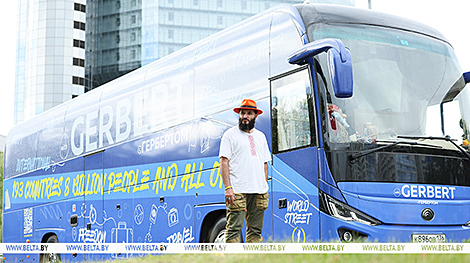
He says he dislikes airplanes and hotels, preferring to carry his home along with him. His bus features a full bedroom with a king-size bed, a shower, a kitchen, two refrigerators, a freezer, a library, and even Picasso paintings. But comfort isn't the point; the message is. Painted on the side: “193 countries 8 billion people and all of us.” That’s the spirit behind Gerbert's odyssey. The Armenian traveler crisscrosses the globe, introducing people to different cultures and championing a deceptively simple idea: judge a person by their actions. BelTA reporters climbed aboard, chatted with Gerbert and his companion Ekaterina, and found out why Belarus became one of the warmest welcome stops on their epic itinerary.
A Home built with their own hands
The story of this unusual bus began with Gerbert's love of travel. He was born in Armenia, lived for several years in Kazakhstan, about ten years in Russia, and another ten to twelve in Germany. Through his work, he traveled to around 30 countries and ran businesses in a dozen states. For a long time, his primary mode of transport was an ordinary seven‑seater minivan. Over 12 years, the vehicle became practically a member of the family, but its mileage exceeded 700,000 km, and it was time to look for a replacement. “I don't like airplanes. Not the plane itself, but all the restrictions: you can’t take this, you can’t take that. I don’t like hotels. So I’ve always traveled in my own car and wanted something bigger,” Gerbert said.
“My goal was to make this motorhome feel like a home, not just a motorhome,” the traveler explained. Almost nothing here needs to be folded away or set up. Everything is fixed: a proper bed, a shower with hot and cold water, a toilet, a kitchen, an oven, two refrigerators, and a freezer. There is a library, paintings, personal belongings, and items from his house and office. ‘I even brought all the dishes from home. All my favorite things that used to be at home, I brought here. I have my bicycle, my clock, maps from Krakow and Minsk. Everything that matters to me is now with me,” Gerbert said.
From a personal journey to a global idea
Gradually, Gerbert’s travels ceased to be mere trips. Behind them emerged an idea – to speak of a person as an individual, rather than as the holder of a particular passport. According to the traveler, he had repeatedly encountered situations during his journeys where attitudes toward him were shaped by his citizenship, documents, or nationality. “They won’t give you a visa there, they don’t like your passport here. It annoyed me. Why are we judged by our passports, rather than by who I am, what I do, whether I create or destroy?” he said.
That is precisely why the words emblazoned on his bus read: "193 countries 8 billion people and all of this is us." Gerbert noted that he would like to dedicate his life to making travel more comfortable, transparent, and safe. Looking ahead, he hopes to develop this idea at the international level. “If a person wants to travel the world, to respect countries, religions, and cultures, they should be judged as a human being,” he believes.
The traveler also spoke of his plans to hold the first “human summit” in Berlin in 2028, where, in his vision, representatives from different countries could discuss a revision of existing approaches to international cooperation.
“Belarus is one of my favorite countries”
Gerbert’s official journey through Belarus was the second leg of his larger project, following Armenia. It was Armenia, where he was born, that served as the starting point of his route, with Belarus coming next. Why Belarus? “I like it here. People understand me here. I know this culture, I have done business here, I know Minsk well. I appreciate the order and cleanliness,” the traveler explained.
He calls Belarus a kind of crossroads between East and West. In his view, the country has managed to preserve its historical roots and values while leaving room for a European culture of communication. “Not once did anyone honk at me, even when I was slow to pull away at a traffic light. No one gave me an angry look or said anything rude. For me, that is an indicator. It is a sign of good upbringing,” Gerbert said.
During his trip, he visited Minsk, Brest, Grodno, Polotsk, Belovezhskaya Pushcha, and the Braslav Lakes, as well as the castles in Mir and Nesvizh. A special place in his journey was Mir Castle, where an encounter left a lasting impression on Gerbert. Several years ago, he had met a guide who told visitors to the castle about the Scots. This time, the traveler met his acquaintance again and even wore an outfit he had bought from him years earlier.
But what impressed him most was Belovezhskaya Pushcha. “I was stunned. There is this patriarch oak tree there, 650 years old. I couldn’t speak for about 30 minutes after seeing it,” Gerbert recalled. His visit to the national park also became an example of what he calls Belarusian hospitality. He arrived without a prior booking and was told that all tours for the day were fully booked. Still, he decided not to leave. In the end, they helped him arrange a private tour, and the bus was allowed to enter the grounds. “I felt at home. The politeness and hospitality were top-notch,” Gerbert said.
In Grodno, he was impressed not only by the architecture and the coziness of the city but also by meeting firefighters. The traveler said he was particularly struck by the people working in the fire service. “All those guys are so motivated, ready to go into action at any moment,” he noted.
Komarovka Market, kholodnik and draniki
For travelers, getting to know Belarus is not just about castles and natural sights. Gerbert advises those visiting Minsk to visit Komarovka Market. “It is one of my favorite spots,” he said.
Impressions are also built through culinary discoveries. Among Belarusian dishes, the traveler particularly singled out kholodnik (cold beetroot soup). “That is probably my favorite dish. And draniki (potato pancakes). But kholodnik is just like nothing else!” he admitted.
According to him, it is these simple things that help one understand a country better. “You can look at photos, read about history, but when you sit at the same table with someone and eat their national dish, that is when you start to truly feel the culture,” Gerbert noted.
“If they come back, it means they like it here”
The traveler says he has a simple way of telling whether someone liked a country or not. “Don’t ask: Did you like it or not? Ask: Would you like to come again? If they come back to that place, it means they felt comfortable and at ease there,” he explained.
Gerbert himself has visited Minsk about 20 times. And that, perhaps, is the best answer to the question of how he feels about Belarus. Yekaterina, Gerbert’s companion, admitted that travel has become a completely new way of life for her. By profession, she is a managing partner in business, but at some point she realized that combining her former career with this new project was becoming increasingly difficult. “My heart called me here,” she shared.
Yekaterina admitted that at first the bus was much less comfortable, and adjusting to this lifestyle was not easy. But gradually the space inside became a true home. “For me, it’s no longer just a hot shower, a toilet, and a comfortable bed. Here are my things, my space, my time. When you see the philosophy behind all of this, the people who come, the stories that unfold, the everyday concerns fade into the background,” she said.
During their joint travels, Gerbert and Yekaterina have visited six countries. For Yekaterina, the opportunity to get to know the cultural codes of different peoples is especially valuable. “It enriches me so much to see how different we all are. I take something from every country. Armenia and Tьrkiye impress me with their hospitality, and Belarus with its decency, cleanliness, and care. It attracts me with its harmonious, calm atmosphere, where you feel genuine care, kindness, and real coziness,” Yekaterina shared her impressions.
She was particularly moved by the Brest Fortress. “That is a place where I experienced so many emotions, as if I had lived through what our ancestors went through,” she said.
On the road again
Where the unusual home will head next after Belarus is not yet certain. The travelers are considering two possible routes: through Tьrkiye and Egypt toward the Arab countries, or through Central Asia toward China and India. “We’re at a crossroads for now,” said Gerbert.
But judging by his words, the main route of this journey has already been determined. It runs not so much along roads and national borders as between people. “I can’t stop people from doing harm to one another. But I want people who don’t want to do harm to have the choice not to. If they want to travel the world and treat all countries, religions, and cultures with respect, they should have that opportunity,” Gerbert emphasized.
And it seems that this is precisely the main meaning behind his traveling home. It is from such seemingly small human acts that the big road is built - the road that Gerbert continues to travel in his house on wheels. The bus will keep moving forward, crossing countries and borders. But the inscription on its side will remain unchanged: “193 countries 8 billion people and all of us”.
Photos by Andrei Sinyavsky,
BelTA.
 print version
 make home page
 add to bookmarks