



Press releases
Flag, faith, and a new generation: How Belarusian gymnastics fought its way back to international circuit
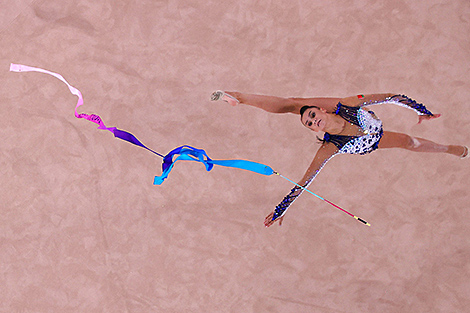
In the summer of 2021, the Belarusian national rhythmic gymnastics team made it into the top 5 in the medal standings at the European Championships in Bulgaria. Back then, no one could have imagined that, for reasons beyond the athletes’ control, the following four European championships would take place without Belarus’ participation, and that Belarus would have to miss three world championships and the Olympic Games. The return to the world stage came five years later, in the very same city of Varna - Belarusian graceful gymnasts immediately reminded everyone of their presence, once again breaking into the top five European teams. In this piece we cover the milestones of the struggle for justice, the reactions of fellow competitors, and the emotions that accompanied the end of a seemingly endless wait.
In March 2022, the International Gymnastics Federation (World Gymnastics), following recommendations from the International Olympic Committee (IOC), suspended athletes from Belarus from tournaments under its jurisdiction. Belarusian athletes were allowed to return to competing on the world stage starting 1 January 2024, but only on the condition of receiving special authorizations and without the use of state symbols. The European Gymnastics Union (European Gymnastics) did not go even as far, as a result of which the Belarusian rhythmic gymnasts missed the qualification for the Olympic Games and the Games.
“Delegates at the European Gymnastics Congress in 2023 voted against our participation in competitions. For us, this was a shock; everyone understood the consequences. The Belarusian Gymnastics Association began active work to bring athletes back to the European arena. We held a series of negotiations with the president of European Gymnastics and members of the Executive Committee regarding the unfairness of this decision, but it could only be changed in 2025, since the Congress is held once every two years,” said Alesya Machulskaya, Secretary General of the Belarusian Gymnastics Association. “The European Gymnastics Charter states that the decisions of the international federation must be respected, but neutral-status admission is an extraordinary case. It is not specified in the organization’s documents, so the European federation made its own decision.”
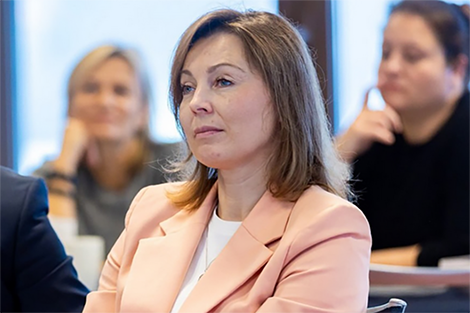
The return of Belarusians to World Gymnastics tournaments in 2024 took place only in individual events. Group disciplines had to wait another year and a half. At the end of 2025, the long-awaited European Congress finally took place in Prague, as a result of which Belarusian athletes returned to competing on their home continent. The next step was to be the removal of the neutral status.
“This was a very difficult hurdle that limited athletes’ participation in international tournaments, since the neutral status verification took anywhere from two to five months. To calculate the timeline and plan a performance at major competitions, we had to submit all documents for analysis in advance. Social media and athletes’ media activity were scrutinized. Additionally, all athletes seeking neutral status underwent doping tests. So this was an extra source of stress for our athletes,” Alesya Machulskaya said.
On 7 May 2026, the IOC recommended that federations restore the rights of Belarusian athletes. The BGA once again appealed to World Gymnastics requesting that athletes be allowed to compete without restrictions, and just one week later, all sanctions were lifted. This time, the European reaction was immediate.
“After consulting with lawyers, the president of European Gymnastics initiated an extraordinary online meeting of the Executive Committee, where a decision was made to allow Belarusian and Russian athletes to compete with their flags and anthems. We had little doubt about a positive outcome, as over the course of several years we had been communicating with representatives of national federations: meeting in person, conducting correspondence explaining the situation. It turned out that some members of the Executive Committee were not even aware of the recent IOC recommendations, so before the meeting we hurried to bring everyone up to speed,” Alesya Machulskaya noted.
According to her, the Belarusian Gymnastics Association maintains friendly relations with the majority of national federations, and many colleagues supported the IOC’s position and were pleased with the return of the Belarusian athletes. The disagreement of certain countries with the decision of the international federation did not prevent Belarusian gymnasts from competing at the European championships with national symbols just three days after the European Gymnastics announcement.
“For several years we competed under the AIN designation, and without knowing surnames, not everyone could tell whether an athlete represented Belarus or Russia. But this time we saw our flag on the standings next to our gymnasts’ names. Both the participants and the fans in the arena were happy to hear athletes from Belarus being invited onto the carpet. In Varna, we received a warm welcome from the stands. Spectators, coaches, and officials approached us to congratulate us on the lifting of sanctions and our return. It was a wonderful feeling.”
The previous major international event with full Belarusian participation was the 2021 World Championships in Japan. Of the competitors from that tournament, only the team’s leader, Alina Harnasko, remains. The Olympic medalist had been considering retiring from elite gymnastics, but after being permitted to compete at the continental championships, she decided to continue her career.
“Five years without World or European Championships is an enormous stretch of time. It was very painful and frustrating to miss those competitions, so I could hardly believe we would live to see our return. Everything changed in the last six months. We actually went to a tournament, and with our own symbols, no less. The realization did not sink in all at once. There were so many emotions. Of course, I felt a huge surge of energy, and once I was in the arena in Bulgaria, I experienced a sense of déjà vu. Everything looked as it used to. I was in my uniform with my flag, just like all the other participants.”
During the years away from the biggest tournaments, Alina did not lack international competition. Belarus’ top gymnast won medals at World Cup and Challenge Cup stages, brought home a string of prizes from commercial tournaments, became a Universiade champion, and helped clubs in France and Spain win national titles.
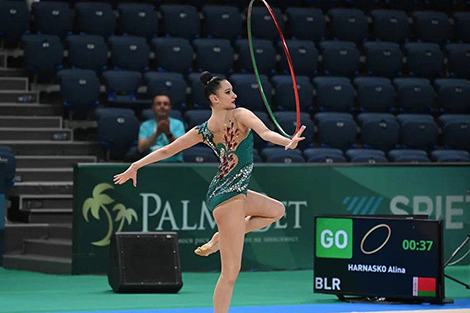
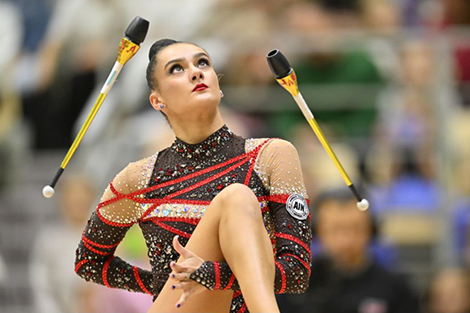
“Even when we could not compete even in neutral status, I had no problem taking part in club competitions. Despite everything, people were watching us all that time, analyzing our routines and results. I have built excellent relationships with clubs in Europe. They knew what I was capable of and invited me every year. And now that we have been fully reinstated, I cannot put that on hold. Those events are important for polishing my routines and bringing them to their best,” Alina Harnasko said.
Alina Harnasko
In the all-around at the continental championships, Alina finished fourth. Ahead of her were the reigning world and Olympic champion, Germany’s Darja Varfolomeev, the host country’s leading gymnast, Stiliana Nikolova, and the season’s World Cup leader, Ukraine’s Taisiia Onofriichuk. These are arguably the best rhythmic gymnasts in the world at the moment.
“Europe has a huge concentration of very strong athletes. In fact, the continental championships are almost no different from the World Championships in terms of the level of competition. In Varna, I avoided major mistakes, but there were small errors. I slowed down in some places and played it safe in others. The competition lasted four days, one day longer than usual. That is quite a long time, so it was difficult to manage my energy and focus,” Alina noted. “This year, I keep finishing near the top three, with a lot of fourth places. My coaches and I are trying to figure out why. We are making the routines more difficult, constantly changing things, and searching for my ideal performance.”
Still, the gymnast brought home a medal from Bulgaria. The hoop final earned her a silver, her sixth career medal at the European Championships. “We work very hard preparing for major events, but we never set a goal that we absolutely have to finish in the top three. Yes, this time it would have been disappointing to return home without a medal. It was so long awaited. But the most important thing is the performance of the routine itself, one that may not only be remembered but also make history. It is very gratifying when the result of your work is seen by thousands of people in the stands and even more on screen.”
If Alina Harnasko was the veteran presence on the team in the individual all-around, the group exercise squad was completely renewed. The gymnasts who had been preparing for the Paris 2024 Olympics did not see the return. Tatiana Nenasheva, who had trained generation after generation of champions, stepped down as senior coach. She was replaced by Maryna Hancharova, a 2012 Olympic medalist who had been working with the junior team, whose members have now moved up to the senior national team.
“A very young squad went to the tournament, one that was forced to miss all the junior World and European Championships. They are, one might say, completely new kids. All that time, we found competitions in Russia and also performed successfully at the II CIS Games. In Bulgaria, we wanted to make a statement and show that group gymnastics in Belarus remains at a high level and that we are ready to rejoin the top countries,” the team’s senior coach emphasized.
The Belarusian team was formed by Palina Aliaksandrava, Sofya Barysevich, Valeryia Malkovich, Hanna Shakun, Kiryana Shevtsova, and Taisa Yerchak. On the world stage, our girls debuted in neutral status only at the beginning of the year at the World Cup. The return of the flag just days before the start of the European Championships became a source of motivation, but also added responsibility.
“Of course, because of their lack of experience, it was difficult for the girls to cope with everything at once. Everyone felt pressure, but not from external factors: it simply arose on its own. I saw how hard it was for them to manage their emotions, and during the last week we had to do a lot of psychological work. It was no longer about physical preparation: it was more about supporting and calming them. At this age and under such circumstances, it’s understandable,” Marina Goncharova said.
At the tournament, all group teams presented routines developed specifically for this season. According to the World Gymnastics calendar, every few years gymnasts must change apparatus: in 2025 the first routine used five ribbons, and the second – three balls and two hoops. Now it is five balls (1st routine) and three hoops plus two pairs of clubs (2nd routine).
“Not long ago everyone was working with one set of apparatus, and at the beginning of the year they had to switch to another. For all teams, the first year after a change is the hardest in terms of bringing routines to perfection,” the specialist noted. “This combination of apparatus will remain until the Los Angeles Olympic Games. Over the next two years, only the compositions themselves will change: adjustments, added difficulty, new music, and so on.”
Despite pre-competition nerves, lack of experience, and limited time to polish elements, our girls delivered. In the all-around, the Belarusian team finished just shy of the podium, and in the final of the five‑ball routine they won silver. According to Marina Goncharova, the medal is even more valuable given the increased competition in group events over the past five years.
“Many countries’ teams have improved significantly. Today it’s very hard to single out clear leaders: the rules are moving toward equalizing the teams. You no longer need some extraordinary physical qualities to receive high scores, as we were used to. Now everyone relies on artistry, which has a major impact on the overall score. There are 8-10 countries that can realistically fight for the top three. And everything depends on how they perform their routine. If earlier some teams could drop an apparatus and still make the podium, now such mistakes are punished very harshly. There is no room for error, and many can take advantage of that. It has become more interesting, but also more difficult,” the head coach said.
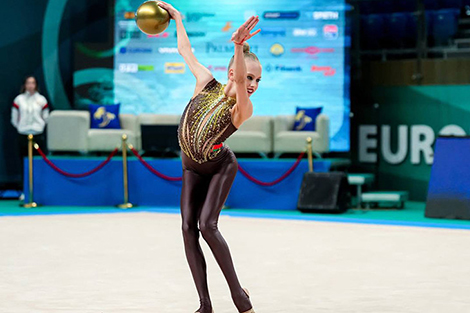
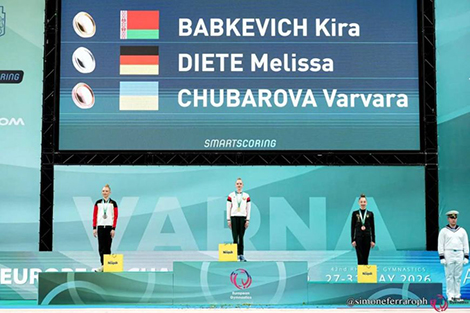
The overwhelming majority of the global gymnastics community supported the return of the Belarusian gymnasts with their flag. A few athletes expressed disagreement through protests during award ceremonies, but these actions found no approval among colleagues. Our team members noted the friendly atmosphere in the Bulgarian arena, as well as fair treatment from the judges.
“We didn’t face major difficulties even when competing in neutral status, because everyone treats our team well. Most athletes spend their time in the gym, constantly training, with music playing everywhere, so there isn’t much time for communication. In any case, many girls speak Russian, so communication isn’t a problem. Overall, the atmosphere was calm, without extra pressure, everything went positively,” Alina Harnasko said.
“We didn’t know how we would be perceived after such a long absence from the international stage. On top of that, we were the ones opening the group competition, which was very nerve-racking. But the impressions were positive, the team was energized. The girls wanted to do more than they are currently capable of. They were thrilled by the audience and the overall atmosphere. We were incredibly happy to perform the first routine so well. The only downside was that we didn’t manage the second one: there were mistakes, and we know what we need to work on,” Marina Goncharova concluded.
In total, Belarus’ athletes won three medals (1-2-0) at the continental forum, with junior gymnast Kira Babkevich earning gold in the ball routine. Next week, the Belarusian rhythmic gymnasts will head to Beijing, where they will compete at the World Challenge Cup stage on 19-21 June. In mid-July, our girls will take part in the World Cup Final in Milan. The main event of the season, the Rhythmic Gymnastics World Championships, will be held in Frankfurt am Main on 12-16 August.
Yevgeny Romantsevich,
BelTA.
 print version
 make home page
 add to bookmarks