


Press releases
Celebrating diversity: Grodno to host Festival of National Cultures
An archive photo
MINSK, 27 May (BelTA) – Head of the Culture Department of the Grodno Oblast Executive Committee Yelena Klimovich told BelTA about the new highlights and beloved traditions awaiting guests and participants at the final events of the 15th Festival of National Cultures, scheduled for 5-6 June in Grodno.
The year 2026 marks the 15th edition of the festival, which is celebrating its 30th anniversary. First held in Grodno in 1996, the event has grown significantly over the decades. The number of nationalities showcasing their culture and traditions has expanded from 11 to 42. With more cultural estates and venues added, the festival program has also expanded, now including a third day of celebrations at the Augustow Canal.
“The core value remains unchanged: no matter what is happening in the world or what turbulent processes are unfolding, our participants gather in Grodno with peace in their hearts and mutual respect. A wonderful atmosphere of friendship prevails at the festival. This truly reflects the reality of Belarusian society and our state, where everyone from the president to ordinary people speaks of all nationalities as ‘our own’ – our Poles, our Lithuanians, our Uzbeks, Tatars, Chuvash, Turkmens... Belarus remains a haven of stability and harmony for everyone living on this land. The Festival of National Cultures, which only grows stronger year after year, is a mirror of our national policy,” Yelena Klimovich emphasized.
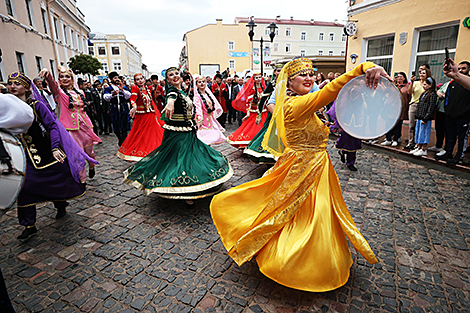
It is no coincidence that the festival has always opened with a parade of nationalities, where 800 participants march shoulder to shoulder through Grodno’s old town. Local residents and visitors welcome everyone with warmth and hospitality. Notably, the event drew a record-breaking 280,000 guests during the 13th edition of the festival.
“The participants will carry a massive Belarusian flag, while the festival flag will be held by women representing various national associations, in honor of the Year of the Belarusian Woman,” Yelena Klimovich said. “This time, the parade will kick off at Sovetskaya Square and head toward Lenin Square. The reason for this is that Sovetskaya Square, which originally hosted the main stage, can no longer accommodate the crowds, whereas Lenin Square is large enough. People will be able to see the parade, watch all the participants walk along the runway, and enjoy the concert.”
Other cherished traditions remain a core part of the festival program. These include planting new trees along the Alley of Friendship in Kalozha Park, which was established during one of the previous festivals and continues to grow with each new edition. Unveiling a new art piece has also become a tradition. In 2026, it will be a sculpture of a deer in the old town.
Every festival introduces its own unique highlights, which typically evolve into new traditions. Examples include the exhibition titled as Belarus: A Gem on the World Tourist Map, highlighting the country’s tourism potential; the organ concert Music of the World’s Nations in the historic Lutheran church; a literary festival; an open-air cinema courtyard; and much more.
A vibrant youth event will be a new highlight of the program. A time capsule with a message to future generations will be buried, delivered to the site by members of Grodno student labor brigades.
“Every edition of the Festival of National Cultures has its own central idea, which serves as a common thread throughout all its events. The concept of 2026 is titled as The Festival of National Cultures: The Celebration of Celebrations. Representatives from all 42 nationalities will showcase their traditional, time-honored holidays and rituals – things that are dear to their hearts, preserved, and cherished. All of this will come together in a single festive kaleidoscope,” the head of the culture department explained.
On the second day of the festival, 6 June, Grodno will not only dazzle with a colorful array of national costumes but will also resonate with a diverse blend of melodies and folk songs. The event will energize the crowd with original dances and entice visitors with the aromas of traditional cuisines. Without exaggeration, no other festival offers a chance to experience so many unique flavors. Around twenty national homesteads will open across the city, expanding their territory even further, with Ozheshko Street added to the traditional locations this time.
At Sovetskaya Square, a massive Belarusian Homestead will showcase the multifaceted culture of Belarusians, represented by all regions of the country, highlighting both the unity and diversity of traditional crafts. Featuring embroidery, woodwork, flax products, pottery, and much more, alongside music, songs, and dances, the venue will offer a creative journey across Belarus.
The evening closing ceremony, featuring the presentation of awards to the participants, will be followed by a performance from the Presidential Orchestra, an Honored Collective of Belarus, presenting their Rock Concert with an Orchestra program.
The third day of the festival traditionally takes place at the Augustow Canal. “Experience shows that after two days, people get tired of the city and gladly move outdoors, to the shores of this unique aquatic gem. The venue also hosts its own festive parade, featuring performances by creative groups from Grodno Oblast,” Yelena Klimovich noted.
At the Augustow Canal, visitors will enjoy the Treasures of Grodno Oblast festival. This venue will host a Grand Belarusian Wedding, where each district will showcase its unique local wedding traditions exactly as they were celebrated by their ancestors. The event will feature brides and grooms in historic costumes, matchmaking rituals, the baking of traditional wedding bread (karavai), and festive banquets. All of this cultural heritage has been revitalized through Authentic Belarusian Wedding project, implemented in the region to mark the Year of the Belarusian Woman. In addition, there will be children’s and sports zones, boat trips on the canal, and festive food and craft stalls.
To truly appreciate the rich tapestry of the festival, there is no better way than to visit Grodno yourself. Come to admire the colorful parade of traditional outfits, sing along to folk songs, join in the lively dances, and sample special delicacies at the national homesteads. You can listen to poetry in the shade of a city park, buy unique handmade souvenirs, and, above all, embrace the very spirit of unity that always fills the air at this exceptional celebration.
 print version
 make home page
 add to bookmarks