




Press releases
Belarusian scientists advance organ transplantation technologies
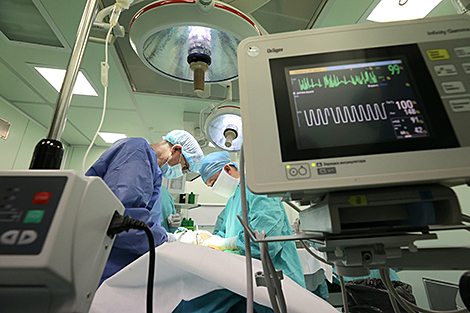
An archive photo
MINSK, 16 June (BelTA) – Belarusian scientists have developed new approaches aimed at improving the effectiveness of organ transplantation, Deputy Director for Research at the Minsk Scientific and Practical Center for Surgery, Transplantology and Hematology Svetlana Krivenko said at a press conference, BelTA has learned.
According to Svetlana Krivenko, organ transplantation worldwide continues to face two major challenges that significantly limit the development of transplant technologies. “The first challenge is the shortage of donor organs. Today, all leading transplant centers are working to address it, and our center is no exception. For more than ten years, we have been developing scientific approaches to improve the quality of donor organs, from interventions at the donor preparation stage after a decision on organ retrieval has been made to the preservation of the transplantable organ throughout all stages. We have also developed programs to prepare recipients for surgery and a range of measures designed to reduce damage to donor organs during preparation and subsequent functioning in the recipient’s body,” she said.
Researchers have developed a prototype of Belarus’ first domestically produced perfusion machine. Using this technology, specialists have created several methods of donor organ preparation that reduce tissue damage, promote faster organ function after transplantation and improve engraftment outcomes. As a result, the number of complications decreases and the overall effectiveness of transplantation increases.
Svetlana Krivenko identified overcoming biological differences between donor organs and recipients as the second major challenge. “An immunological conflict inevitably occurs, and it is virtually impossible to avoid completely,” she noted.
Various drug regimens and donor-recipient matching strategies are currently used to address this issue. According to the researcher, Belarusian specialists have successfully employed biomedical cell products to enhance treatment outcomes. “Our center is the country’s largest producer and user of biomedical cell products. Among them are products based on mesenchymal cells whose primary proven mechanism is immunosuppression. We used this property to develop new treatment methods. Conventional immunosuppressive drugs effectively suppress immune rejection but are highly toxic to the liver and kidneys. Cell therapy has enabled us to reduce the dosages of these medications,” Svetlana Krivenko explained.
The methods developed by the center have been tested over nearly a decade and have proven their effectiveness.“In this area, our center is one of the global frontrunners. Today these methods have been incorporated into healthcare standards and included in the clinical protocols of the Belarusian Healthcare Ministry,” she said.
 print version
 make home page
 add to bookmarks