



Press releases
Belarusian political scientists comment on results of sociological survey
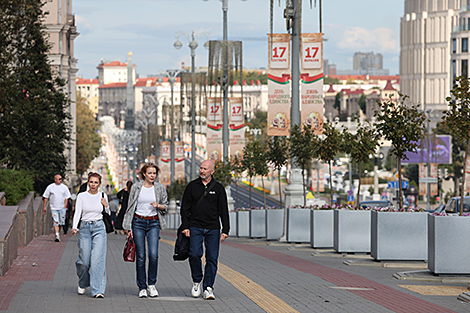
An archive photo
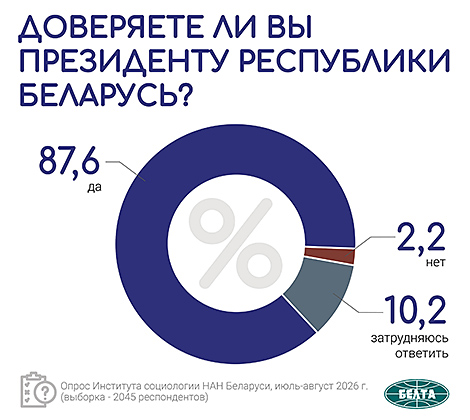
MINSK, 17 September (BelTA) – A nationwide sociological survey shows that 87.6% of Belarusians trust the Belarusian president. His efforts to ensure domestic security and preserve peace amid a tense international environment earned the highest marks. Two parts of the survey on social and economic topics and on social and political issues were presented in Minsk in September, BelTA has learned.
Political scientist Vadim Gigin noted that the poll results show a stable perception of the presidency and the head of state as a key political institution. “The presidency in the Republic of Belarus, and Aleksandr Lukashenko personally, consistently enjoy the highest level of public trust among other political institutions,” Vadim Gigin said.
According to him, particular attention should be paid to the link in public perception between peace and national security and the work of the president. “We see the consolidation of Belarusian society around the idea of peace and preserving national security. And here, undoubtedly, Belarusian president plays the key role,” Vadim Gigin stressed.
He noted that amid a difficult military and political situation, the role of the head of state as Commander-in-Chief and his efforts to preserve peace take on particular importance. “The fact that peace and security are firmly associated with the head of state is significant,” the political scientist note.
Security and peace
Nearly 90% of respondents rated the president’s efforts to ensure security inside the country as successful, while 89.8% gave a positive assessment to his efforts to preserve peace in the country amid a tense global situation. According to political scientist, delegate to the Belarusian People’s Congress Vadim Borovik, citizens’ perception of security is shaped by a whole range of factors directly related to quality of life. “Security is not only security in the sense of having peaceful skies overhead. It is also security in the economic and social sense,” he said.
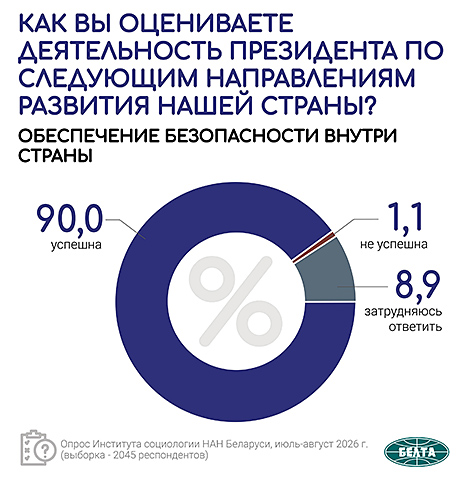
The political scientist noted that this range of factors includes social protection, access to healthcare, public order, road safety, citizens’ ability to receive assistance and protection from the state and law enforcement agencies.
Speaking about preserving peace, the political scientist stressed that this task requires a systemic approach and relies not only on diplomatic efforts. “In order to be strong and independent, in order to ensure peace, we need a strong economy and a stable social and economic environment,” Vadim Borovik stressed.
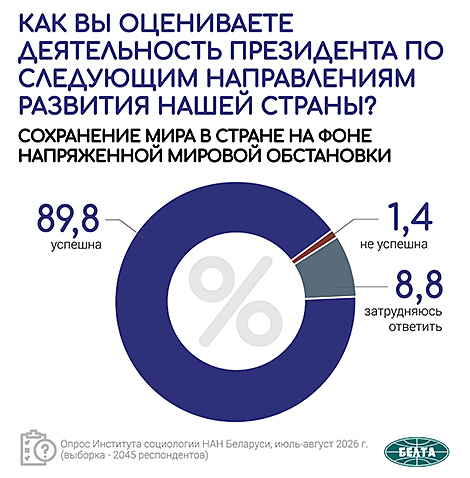
According to him, ensuring peace is linked to the state’s defense capability, the training of the Armed Forces, economic resilience, and stability in the social field.
International standing
As the survey shows, 81.2% of those polled gave a positive assessment to the president’s efforts to strengthen Belarus’ international standing. According to Vadim Borovik, the nature of the country’s foreign economic and foreign policy ties plays an important role in this area. “We always build relations based on the principle of mutual benefit and the attractiveness of mutually beneficial cooperation,” the political scientist said.
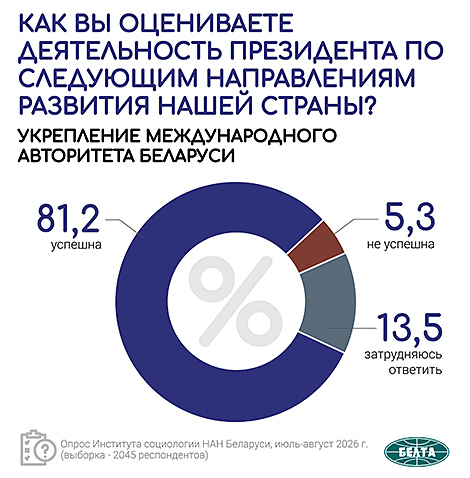
He highlighted Belarus’ cooperation with Russia, China, and countries of the ‘far arc’, and its interest in normalizing relations with the collective West. According to him, another area remains the diversification of foreign trade and expansion of the number of partners. International cooperation is viewed from the perspective of mutual economic interest and practical returns.
Regional development
A total of 75.4% of respondents consider the president’s work on developing Belarus’ regions successful. Around 15.3% found it difficult to assess this area, while 9.3% gave it a negative assessment. Vadim Borovik noted that regional policy is aimed at achieving more balanced development across the country, creating jobs and developing the necessary social infrastructure. “We are interested in ensuring that the workforce and citizens of Belarus are distributed more evenly across the country,” he stressed.
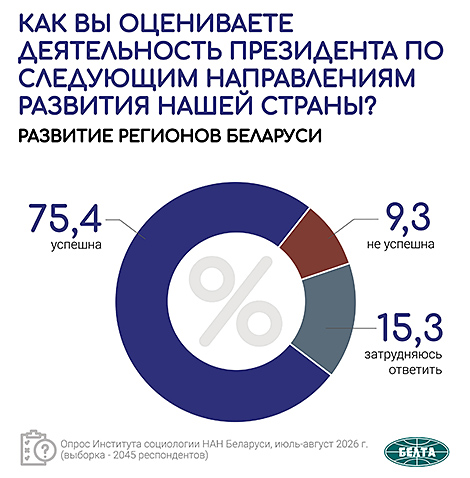
According to the political scientist, this includes the development of small towns and District centers, creating employment opportunities, developing social infrastructure, and satellite cities. This approach helps create conditions for people to live and work in different regions of the country and prevents excessive concentration of economic activity in the capital.
Social and economic stability
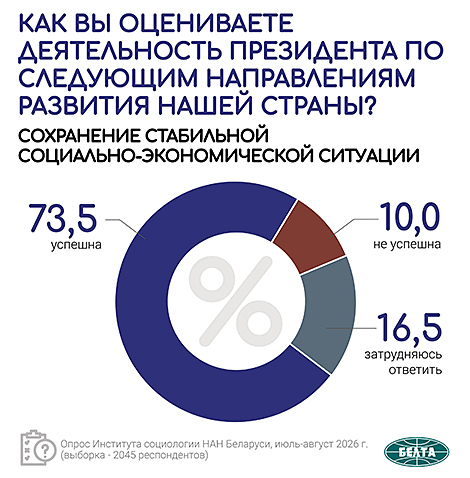
The poll shows that 73.5% of respondents gave a positive assessment to the president’s efforts to maintain a stable social and economic situation. According to Vadim Borovik, economic resilience is directly linked to the state’s ability to fulfill its social commitments, ensure employment, and maintain people’s income levels. Among the key areas, he cited industrial development, entering new markets, expanding cooperation with China and Russia, and work with countries of the ‘far arc’.
The political scientist stressed that the introduction of modern technologies and development of new economic sectors are becoming particularly important. “For us, the effective functioning of the economy, the introduction of innovative technologies into the production process, the creation of biotechnology hubs, a logistics hub, and IT technology hubs are very important areas,” Vadim Borovik said.
He stressed that economic resilience means not only maintaining the level already achieved, but also looking for new growth points, developing innovative industries, and expanding opportunities for further economic development.
In July-August 2026, the NASB Institute of Sociology conducted a comprehensive nationwide sociological survey commissioned by the Belarusian Institute for Strategic Research (BISR). The poll surveyed 2,045 respondents from all regions of the country.
 print version
 make home page
 add to bookmarks