


News & Events in Belarus
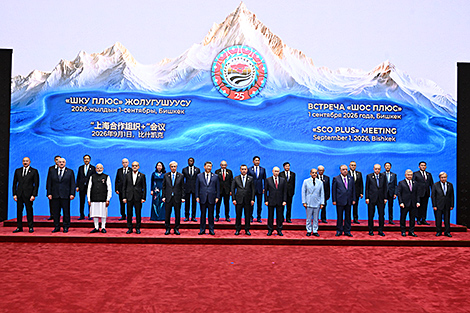
Time of concrete deeds for SCO, too. Lukashenko’s address to SCO Plus summit participants
The Belarusian economy, which is geared towards export and is open to cooperation with all interested countries, cannot develop while relying solely on domestic resources and assets. Among other things Belarus sees development prospects in cooperation with the largest countries: Russia, China, and India. Multilateral formats are as significant. The Shanghai Cooperation Organization, which represents over 40% of the planet’s population and accounts for a quarter of the world’s GDP, occupies a special place in this regard.
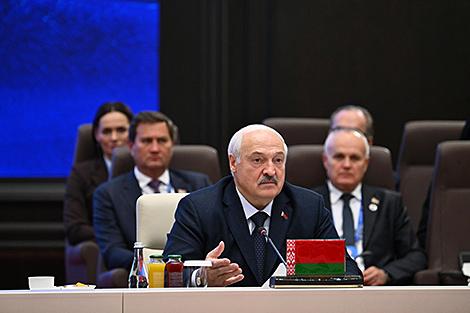
Not so long ago at a session of the 7th Belarusian People’s Congress Aleksandr Lukashenko formulated a slogan: “Time of concrete deeds”. It applied to Belarus first and foremost. During the SCO Plus format summit of the Shanghai Cooperation Organization the president expanded the scope of the slogan formulated at the Belarusian People’s Congress onto the entire “Shanghai family”. With the outspokenness he is known for, the head of state spoke about accomplishments of the Shanghai Cooperation Organization as well as certain shortcomings in the organization’s work. The Belarusian leader urged countries of the “Shanghai family” to act more decisively in order to avoid important problems and avoid becoming another United Nations Organization in its current form.
The key theme of the SCO Plus format meeting was “UN as a key element of a just world order: The contribution of SCO Plus states to the formation of a multipolar world”. The head of state congratulated Kyrgyzstan on getting elected as a non-permanent member of the UN Security Council: “I see a sign of responsible commitment to this high mission in the chairmanship’s initiative to discuss the UN as a key element of a just world order and the contribution of the SCO family states to shaping a multipolar world.”
The impact of political differences of opinion inside the UN on conflict resolution
Aleksandr Lukashenko stressed that the United Nations is unique in its universal mandate, broad composition, focus on dialogue, and the development of approaches that can take into account the interests of all countries as much as possible. “Even the smallest states are given a chance by the UN podium to draw the world’s attention to their problems and ask for help in solving them. That is the strength of the Organization,” he said.
At the same time, the president believes that very often political disagreements block real UN involvement in resolving unprovoked armed conflicts, including those involving one of the SCO member states – Iran. “You can criticize the Organization as much as you like (there are reasons for it), as well as its Secretariat leadership, but we must remember that the results of the UN’s work depend first of all on us, the member states,” he said.
Tighter interaction between the SCO and the UN
The president remarked that there are four UN Security Council members in the “Shanghai family”: Russia, China, Pakistan, and Bahrain, including two permanent members. Kyrgyzstan will become a non-permanent member instead of Pakistan in 2027.
“You are perfectly aware of how large the share of SCO countries in the world population and economy is. Without members of our association it is impossible to resolve a single problem such as climate change, fight against pandemics, or the stabilization of energy markets,” Aleksandr Lukashenko is convinced.
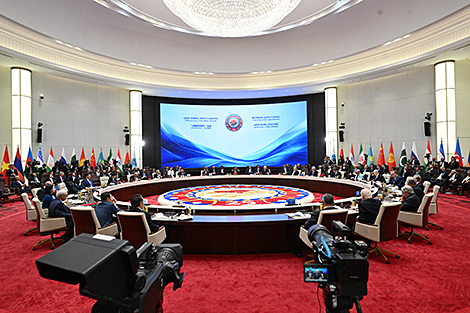
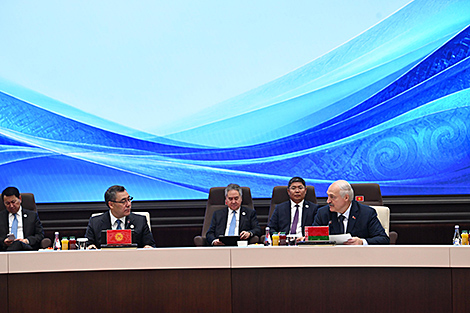
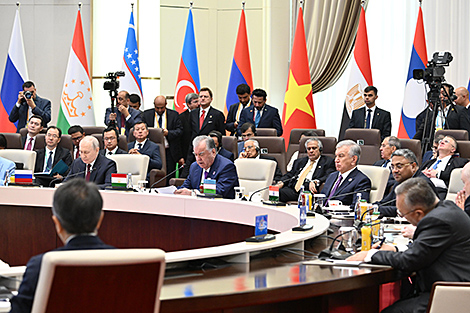
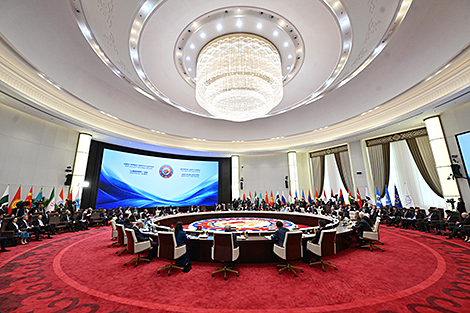
He stressed that Belarus expects tighter interaction between the Shanghai Cooperation Organization and the United Nations Organization to produce an effect. “In our own format we are capable of promoting the solutions that have come to a halt in New York due to opposition from the West in such areas as promotion of international peace and security, fight against terrorism, cyber threats, and drugs trafficking,” the head of state said.
The president believes that in the economic dimension the Shanghai Cooperation Organization is capable of effectively implementing the initiatives that the UN cannot approve and that are aimed at fighting unilateral coercive measures, at stimulating mutual investments, simplifying customs procedures, developing the digital economy and transport connectivity.
Need for concrete actions towards multipolarity
The president noted that by working out a consensus on various topics in the Eurasian space, the Shanghai Cooperation Organization creates a solid foundation for resuming a full-fledged global dialogue. He pointed out that during the session of the SCO Heads of State summit prior to the SCO Plus format meeting a lot had been said that the most important events in the world must not happen without the Shanghai Cooperation Organization.
“All of us understand that. We say that we have some spirit and so on. But it is not enough. People expect us to take concrete actions towards multipolarity. Time is slipping away. If we lose time, we may become the United Nations Organization the way it exists now,” Aleksandr Lukashenko said.
At the same time, the president noted that in the future the Shanghai Cooperation Organization may act as a catalyst of the United Nations Organization’s rehabilitation, may give back the UN the status of a platform for resolving the world’s most complicated problems instead of a tool used by the West to put pressure on sovereign and independent states. “But we are also afraid of talking about it for some reason,” he stressed.
The role of the Eurasian Charter of Diversity and Multipolarity in the UN’s renewal
Aleksandr Lukashenko noted the renewal of the UN depends not so much on who leads it, but on fostering a culture of interstate conduct grounded in mutual respect and dialogue.
“I am convinced that the development of the Eurasian Charter of Diversity and Multipolarity in the 21st Century will contribute to this process,” the president stated. “At the upcoming session of the UN General Assembly, the negotiation process on the development of the Charter will be officially launched. In practical terms it will begin at the annual Minsk Conference on Security in the capital of Belarus this November. Taking this opportunity, I would like to invite you to this conference.”
Proactiveness on the part of the most powerful states
Concluding his speech, Aleksandr Lukashenko once again reaffirmed Belarus’ commitment to contributing to the work of the SCO, sharing experience in priority areas of cooperation, strengthening the UN, and helping shape a just and multipolar world order.
“We are ready to act actively and purposefully. Frankly speaking, this is what we expect from the organization’s leaders, too. No matter how equal we all are here, we still acknowledge that we have three most powerful states: the People’s Republic of China, India, and the Russian Federation. Nuclear countries with powerful economies and resources. We expect them to be proactive, first and foremost. Unfortunately, there is no proactiveness yet,” the Belarus president stated.
 print version
 make home page
 add to bookmarks