




Business news
Shops, marketplaces, markets? Survey reveals where Belarusians shop
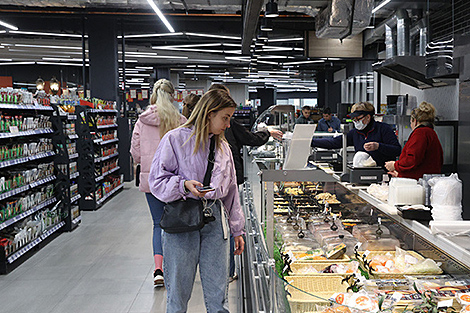
An archive photo
MINSK, 23 September (BelTA) - Shops remain the main places for purchases in the everyday life of Belarusians. These are the results of a comprehensive nationwide sociological survey covering current issues on the international and domestic agenda, BelTA has learned.
Shops remain the key places where Belarusians make their purchases. In traditional shops, the majority of respondents prefer above all to buy the following goods: 95.1% - food and beverages, 77.8% - cosmetics, hygiene products and household chemicals, 70.3% buy clothes, footwear, accessories and jewelry there, and 67.9% - household appliances and gadgets.
Director of the Institute of Sociology of the National Academy of Sciences of Belarus Nikolai Myslivets said that young people, compared with other age groups, make broader use of marketplaces and online stores.
Food and beverages are bought on marketplaces by 6.3% of respondents aged 18 to 30, and in online stores by 5.8% (the national figure is 4.7% and 4.2% respectively).
Cosmetics, hygiene products and household chemicals are bought on marketplaces and in online stores by 37.1% and 17.1% of the young people surveyed respectively (nationally - 25.6% and 11.4%).
Clothes, footwear, accessories and jewelry are bought on marketplaces by 54.7% of respondents aged 18 to 30, and in online stores by 30.0% (nationally - 34% and 19.1% respectively).
Household appliances and gadgets are bought on marketplaces by 21.8% of respondents aged 18 to 30, and in online stores by 38.4% (nationally - 16% and 27.2% respectively).
The sociological survey was conducted in July-August 2026 by the Institute of Sociology of the National Academy of Sciences of Belarus on behalf of the Belarusian Institute for Strategic Research (BISR). The study involved 2,045 respondents from every region of the country. The first part of its results, on current issues of Belarus’ social and economic development, was presented in Minsk on 10 September. The second part, on social and political topics, followed on 16 September. On 23 September, sociologists presented the third part, covering current issues on the international and domestic agenda.
 print version
 make home page
 add to bookmarks