




Business news
Rogozhnik: Belarus has solved key problem on the Russian market
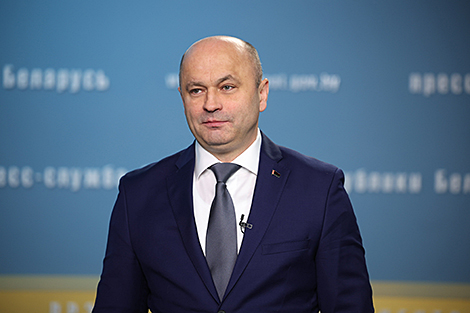
MINSK, 5 January (BelTA) – After reporting to the president, Ambassador Extraordinary and Plenipotentiary of Belarus to Russia Aleksandr Rogozhnik told journalists about the most significant problem that Belarus has managed to resolve on the Russian market, BelTA has learned.
“Last year we resolved the most critical issue [on the Russian market] – securing access for our manufacturing industry to all programs implemented in Russia. Today, Belarusian products stand on equal footing with Russian ones. We compete under normal economic conditions, where only the strongest prevail,” he said.
Characterizing the Belarus-Russia trade and economic cooperation in 2025, Ambassador Aleksandr Rogozhnik stated that exports to Russia grew by 2.3% in January-November, which he described as “an excellent indicator”. “At the beginning and middle of the year, no one expected that we would be able to successfully resolve the complex issues we faced and actually reach a record level of exports – not only of goods but also of services,” he emphasized.
Although the target of 5% was not achieved, prompting criticism from the head of state, particularly regarding the machine-building sector, which performed slightly worse than in previous periods, the diplomat noted: “If we look at the results over the past four years as a whole, there has undoubtedly been growth in this area. Despite the slowdown in the Russian economy, we have not allowed a significant decline in our exports. By focusing on cooperation with the regions, we have managed to preserve a solid foundation in this sector as well.”
According to data, in January-November 2025 trade between Belarus and Russia increased by 3.6% compared to the same period in 2024, amounting to $49.2 billion. Belarusian exports nearly reached $25 billion, increasing by 2.3%. The main export items included cheese and curd, butter, passenger and freight vehicles, petroleum products, and parts and accessories for cars and tractors. There is reason to believe that by the end of 2025, bilateral trade will exceed the $50 billion mark.
 print version
 make home page
 add to bookmarks