



Business news
Belarus’ self-sufficiency in milk production at 300%
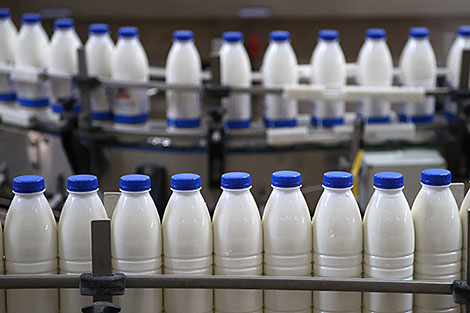
An archive photo
MINSK, 4 June (BelTA) – Belarus’ self-sufficiency in milk production has reached 300%. Deputy Director for Scientific Work at the Institute of System Researches in Agro-Industrial Complex of the National Academy of Sciences of Belarus Svetlana Kondratenko made the statement during the discussion panel “Export potential of the dairy industry of Belarus” on the sidelines of the Belagro expo in Minsk, BelTA has learned.
Svetlana Kondratenko noted that Belarus possesses a significant export potential. “These are dairy products, beef, poultry meat, sausages, baby food, sugar, vegetable oil, and many other popular products. Our country plays a significant role in building regional food security within the framework of the Eurasian Economic Union. The republic accounts for more than 40% of the total trade volume,” she said.
During the meeting with the heads of government delegations participating in sessions of the Eurasian Intergovernmental Council and the CIS Council of Heads of Government which took place on 30 September 2025, the president voiced an essential thesis determining the strategic vector of Belarus’ efforts in the international space. This is not just the development of agriculture but food security – a matter of social stability and, without an exaggeration, of the existence of peoples and states, the deputy director pointed out.
“According to the latest data, the self-sufficiency level in milk production has reached 300%, in meat – 140%, in eggs – 130%, in vegetables and potatoes – over 100%. Agricultural products account for 24% in the structure of commodity exports of the Republic of Belarus. Such a high level of domestic production allows us first and foremost to saturate the domestic market with high-quality domestic goods at affordable prices for the population and not to depend on any fluctuations in market conditions. I’d like to note that products of animal origin traditionally make up about 60% of the Belarusian food export basket: 40% is dairy products and about 20% is meat and meat products,” she said.
Among the key advantages of the country on the global food market Svetlana Kondratenko named the positive image of Belarus as a reliable supplier of high-quality and organic foods, a well-developed own raw material base, a modern processing infrastructure and, of course, scientific support which fully covers the entire agrofood chain: from the production of high-tech goods to high-quality storage and processing of agricultural raw materials.
“All these components allow us to successfully develop competencies on the most competitive markets,” the deputy director pointed out.
The export potential in the field of production of animal husbandry goods, in particular dairy products, is determined by the well-developed intensive animal husbandry industry, which provides a sufficient raw material base and an opportunity to export products without damage to the domestic market, Svetlana Kondratenko said. “Belarus’ gross milk output grows every year thanks to rising cow productivity which has reached 6,500kg per year,” she specified.
Belarus’ export potential on the market of dairy products is determined, among other things, by the fact that the products are in demand on the EAEU market. This is evidenced by the data of the Eurasian Economic Commission regarding the level of availability of basic food products, Svetlana Kondratenko added. “We see that the market is not yet saturated with dairy products and Belarusian products will be in demand. A positive dynamic is observed on the EAEU market and the global market, which will allow us to expand supply volumes, earn on exports, and explore new market niches. Under the influence of the growing population numbers and income growth, primarily in developing countries, the demand for dairy products will grow by about 2.7% per year according to FAO estimates,” she said. “In conditions of rising prices for energy and other resources on the global market the growth of raw milk production for many producers, even large ones will be limited, since the costs of feed and fertilizers are increasing. But for our country this is first and foremost an opportunity to strengthen its positions on the growing export markets of Asia, Africa, and the Middle East. Of course, the EAEU and CIS countries remain priority consumers of our dairy products.”
High-quality Belarusian products fully meet consumer demands for healthy nutrition – this is a fashionable trend today, Svetlana Kondratenko noted. “Our producers can fill all these segments given that the domestic dairy product lineup is developing. These are cheeses with a high content of protein and calcium, yogurts, functional products enriched with dietary fibers and vitamins, specialized products for children, and a large lineup of other items,” the deputy director concluded.
 print version
 make home page
 add to bookmarks